Optics Basics
Telecentric vs. Conventional Lenses
Published
Why precision gauging demands telecentric optics — it starts with perspective error.
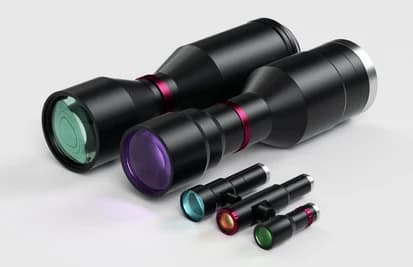
A conventional (entocentric) lens changes magnification with object distance: the closer the part, the bigger it images. That is perspective error. In dimensional gauging, a few millimetres of height variation or placement offset is enough to introduce percent-level errors.
How telecentric optics remove the error
In an object-space telecentric lens the chief rays are parallel to the optical axis on the object side, so magnification stays constant across the whole depth of field and moving the part does not change its imaged size. Bi-telecentric designs are telecentric on the image side as well, further reducing sensitivity to camera mounting.
When a conventional lens is still fine
Alignment, barcode reading and presence/absence checks do not depend on absolute dimensions, so a cost-effective FA fixed focal lens is the right tool.
Can't find what you're looking for?
We're here to help. Send us your requirements and our engineers will recommend the right solution.
Contact Us