Application Notes
Why Collimated Backlights Decide Your Measurement Accuracy
Published
Same telecentric lens, different backlight — edge localisation accuracy can differ by an order of magnitude.
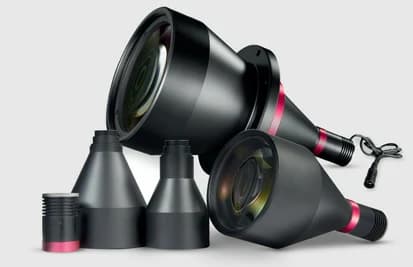
Profile measurement lives and dies on the grey-level transition at the edge. A diffuse source creates a soft penumbra around the part, and sub-pixel edge algorithms struggle to converge on it.
What collimation changes
A telecentric backlight collimates the LED output before it reaches the part, compressing the transition zone to a very narrow band. Paired with a telecentric lens this produces a steep black-to-white step. In practice edge repeatability typically improves from ±3 pixels to ±0.3 pixels.
Selection tips
The clear aperture of the illuminator should exceed the lens field of view, and its collimation angle should match the telecentricity of the lens. Blue or green wavelengths give a smaller diffraction blur than red.
Can't find what you're looking for?
We're here to help. Send us your requirements and our engineers will recommend the right solution.
Contact Us